
Last Updated on 7 Nov, 2025
So you’re planning a trip backpacking in Thailand, and you want to make sure it’s full of fantastic vegan food, and it’s an ethical experience? SO exciting! The time I spent in Thailand was amazing, and it’s definitely on my top 5 countries to return to again in the near future. There’s something to be said about the kind people, sandy beaches and clear blue water, and how easy it is to travel around and meet other backpackers that makes it perfect for vegan travel and backpacking.
This post covers:
- How to find vegan options in Thailand
- How to ask for a meal to be made vegan
- Travel tips to find the best vegan food and street food around Thailand
- The best vegan food hotspots in Thailand
- Whether going on a tour to see elephants is an ethical and vegan thing to do
Table of Contents
Is eating vegan easy in Thailand?
YES! Walking down the streets of Thailand there will be fresh markets and fruit stands, supermarkets, 7-11s on every corner with vegan-friendly snacks, and in certain areas of Thailand you’ll find lots of delicious vegan-friendly restaurants.
The concept of veganism has been present in Thailand for hundreds of years, and Buddhists often follow a vegan diet. In Thailand, it is known as “jay” and is written like: เจ (It kind of looks like the number 17 when you see it). Often there will be yellow and red signs with ‘เจ‘ written on them to signify something is vegan.
Something to note though is that Buddhists may also avoid foods that are actually vegan-friendly, such as onion and garlic, so something labelled as jay might exclude a lot more than what you’d usually avoid!
It’s usually easy to find soy milk in supermarkets, and ingredients are often in English which makes finding out if a convenience food is vegan super easy. Dairy is not a staple in Thai cuisine, fortunately. This means if something is on a menu and marked as vegetarian, it’s usually vegan too, but check when you’re ordering as it could contain egg. If it does include egg, you can ask for it to be left out. On the subject of dairy, for some reason, cow’s milk tends to be a common ingredient in Thai bread?! So I avoided eating bread whilst in Thailand unless I was eating somewhere that was 100% vegan.
TIP: If you need to read the ingredients label in Thai, use the Google Translate app on your phone. In the app, choose the Camera option and take a photo of the ingredients list. It’s not perfect, but should help you work out whether something is okay to eat or not.
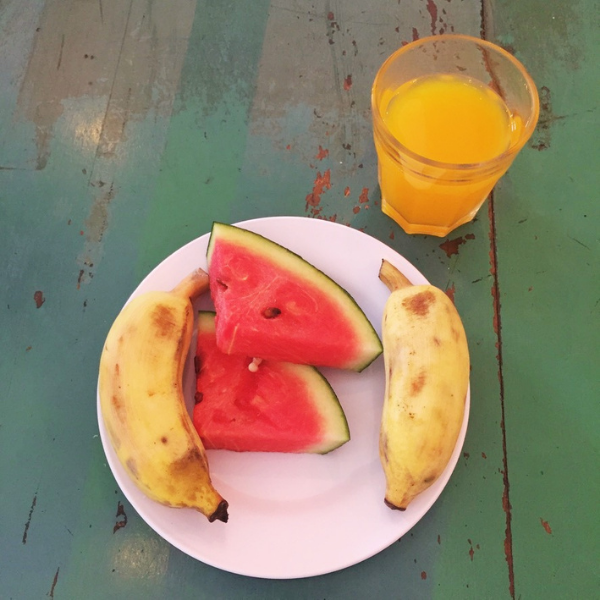
When I book hostels, I also like to read the reviews first to see what the vegan options are like, especially if there’s a café on-site, or breakfast is included. I will always mention this kind of thing when I write reviews of places I’ve stayed in too, to help other travellers! Most often I would eat a mix of fruit or oats with coconut milk and banana for breakfast, but I also managed to have vegan pancakes a few times, or cereal with soy milk.
Also see: The Ultimate Packing List for Backpacking Southeast Asia
However – that’s not to say that eating plant-based food in Thailand is always easy. There are definitely things to contend with, such as the fact fish sauce tends to be in loads of Thai dishes (as I talk about in the next section), condensed milk can be found in lots of Thai desserts and fruit smoothies, and shrimps seem to get everywhere, too. If you go off the beaten track, eating vegan food will be much harder than in the cities like Bangkok and Chiang Mai unless you are with someone who can help communicate your diet in Thai. My first night in Thailand I was sat in a vegetarian restaurant in Bangkok eating my way through the menu, and got chatting to another solo traveller on a nearby table. He was actually in Thailand learning Thai, and wrote down a few helpful phrases for me to use on my travels if I ever got stuck! I never needed to use them, but knowing how to communicate what you want is key (and I offer some tips on doing this later on).
Fear not, though. You’re not going to go hungry! Read on to learn more about how to experience the exceptional cuisine of Thailand.
How easy is it to eat vegan classic Thai cuisine?
If you want to eat traditional Thai food (and why wouldn’t you? It’s delicious) there are plenty of vegan options for you! Traditional Thai cuisine includes lots of vegetables, fruit such as pineapple, fried rice and sticky rice, noodles and tofu.
Things can get tricky with ingredients such as fish sauce and chicken broth, which food is often cooked with for flavour. Pad Thai (Pad Thai Jai) traditionally includes egg, and shrimps appear often, too. You can ask for egg to be left out of meals, but sometimes it is trickier to leave out fish sauce if they’ve made big batches of the food. It’s always worth asking, though.
Some great meals to try include mango sticky rice, pineapple fried rice (make sure there’s no egg), veggie stir fry + tofu (again, make sure there’s no egg or fish sauce), vegetable spring rolls and vegetable tempura.
Tip: mango sticky rice is a classic Thai dessert that is conveniently vegan and delicious. Look out for it on the menu as Khao Niaow Ma Muang.
Is it possible to eat vegan street food?
Like many countries in southeast Asia, Thailand has some amazing street food and night markets.
Whilst you might be able to order a vegan meal at a market, unfortunately the food will often be cooked in a pan that has also been used to cook meat in, unless you’re buying food from a vegetarian/vegan food stall. This is up to you to decide whether you’re happy eating food that’s cooked like this. If you aren’t, the easiest option might be to eat at specifically-veggie restaurants and cafés.
How do I ask for something to be made vegan?
It’s always good to know how to say “I’m vegan” in whatever country you’re travelling to, and Thailand is no different.
If you want to say “I am vegan”:
Chan ghin jay (if you’re a woman)
Pom ghin jay (if you’re a man)
If you want to say “no milk”:
Mimi nom
A great app to have on your phone is Vegan Passport, which is a multilingual phrase-book to use around the world to communicate the fact you’re vegan! It can also be bought as a book. I don’t get any money for recommending this product, it’s just something that I think is genuinely useful to have.
Another AMAZING resource I’ve found are the free to download audio clips from The Thailand Life which you can play on your phone when ordering food to allow you to communicate what you want to say in Thai! I’m definitely going to use them the next time I’m in Thailand.
The best vegan hotspots in Thailand
There are an abundance of vegan restaurants around Thailand if you’re in the right place, especially if you’re in a city, such as Chiang Mai or Bangkok. These restaurants are mostly aimed at tourists, and are therefore much more expensive than eating at Thai restaurants or from a street stall (but I wouldn’t say they’re more expensive than the restaurants I’d usually go to in the UK, by any means). I also found Koh Phangan particularly good for vegan food, and I had vegan burgers, vegan pizza, falafel and salad and amazing smoothie bowls. It really varies where you go in Thailand as to what the offerings are like, and that leads us onto our next section – about finding vegan restaurants.
How do I find vegan restaurants in Thailand?
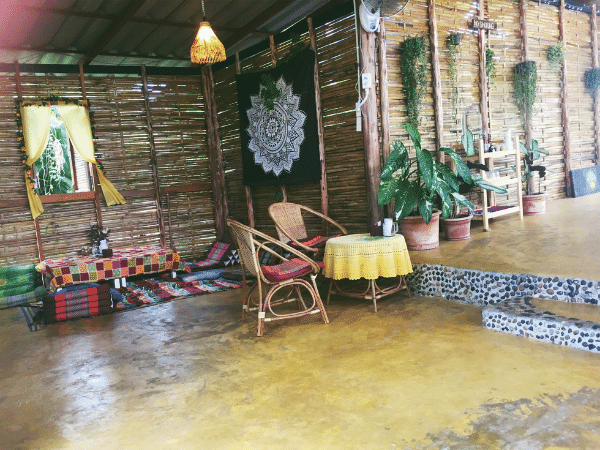
Whenever I was on my way somewhere new while backpacking in Thailand, I’d enjoy searching online for recommendations for places to eat so I’d know what to have for dinner that night, and as soon as I got off the bus I’d go straight onto HappyCow! HappyCow is an app that you can use worldwide to see what vegan-friendly restaurants, cafés and shops are nearby! You can also filter the results to show places that are currently open, which is perfect when you’re hungry right now. You can also just use the website to search by location, and I’ve discovered some really great places by using it that I never would have known about otherwise. If you discover something that isn’t on the app you can also add it to help other vegan travellers like you.
Also see: Eco-Friendly Travelling – 15 Tips on How to be More Sustainable
Is going on a tour to see elephants an ethical and vegan thing to do?
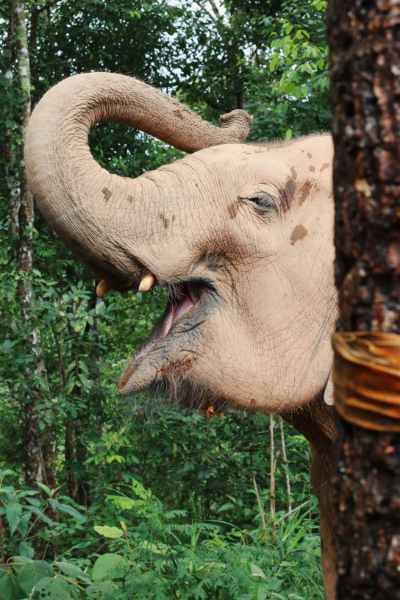
This is a difficult one to answer, and that’s because not all companies are the same, and largely because it can be difficult to tell how ethical an organisation actually is, how it is being run, and how well the animals are being cared for, even when you’re actually there. You don’t always know what goes on behind scenes. Elephant experiences advertised towards tourists will often be unethical and elephants will be chained up, beaten, ridden by humans and kept in poor, cramped conditions.
For an elephant experience to be vegan, it can’t harm the elephants, and that 100% includes riding them. Riding an elephant is not vegan. I always like to think of it like this: does this activity or place exist for human entertainment/use, or does it exist for the benefit of the animals themselves? An ethically-run elephant sanctuary exists as a refuge for animals, and the opportunity to ride the animals themselves is clearly for human entertainment and it harms, rather than benefits, the elephants.
Animal tourism is a really big problem in Thailand. A really good article I recommend reading is ‘Suffering unseen: The dark truth behind wildlife tourism‘ published by National Geographic if you want to learn more.
However, I do believe it’s possible to see elephants in Thailand in an ethical way that aligns with vegan values. For example, Elephant Nature Park is an ethical organisation that cares for elephants that have been rescued from their previous lives in captivity performing for tourists in awful conditions.
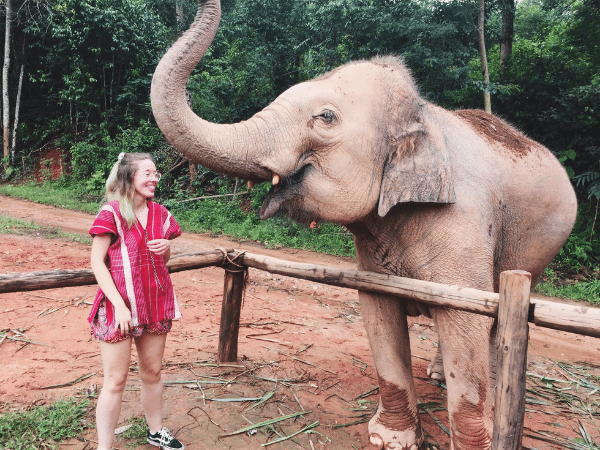
In 2018, ( had a day’s experience with Elephant Nature Park doing the ‘Karen Elephant Experience’, where you are able to see three retired elephants and help care for them (such as by feeding them bananas, which they seem to love even more than I do, which is saying something). On the coach journey north of Chiang Mai (we had to go up into the mountains!) we watched a video about elephant tourism in Thailand and how poorly they’re often treated. We were taught how to interact with the animals and how to behave appropriately.
The elephants walked around the jungle, and we followed. Nobody led them anywhere, and we were told that if they didn’t want to walk then we wouldn’t either – we were there to observe, which is exactly what I wanted. The elephants weren’t tied up or chained at the ankle, and they were able to forage for themselves in the trees.
There are other ethical animal sanctuaries that exist, but I recommend you really do your research beforehand.
Update: In 2023 I went back to Elephant Nature Park, and did the ‘Caring For Elephants’ experience, and I was able to see more of the actual animal sanctuary. I vlogged the entire day, which you can watch here.
So, what can you do to avoid participating in unethical animal tourism?
It’s up to you to do your research and only give money to companies that do not harm animals (you might see experiences with other animals, such as bears or tigers, also being advertised). I would only ever go with a company that I know exists to benefit elephants, and I’d definitely read reviews online beforehand. Do not take it for granted that a company cares for the animals. Do not turn a blind eye to the cruelty that these animals endure. Avoid doing any activities with companies that offer elephant rides, or unethical elephant experiences.
I also think it’s important to gently educate others, especially people you’re travelling with, other travellers you meet who mention they want to see elephants, and your friends and family who are going on their own adventures.
To summarise:
- Backpacking in Thailand as a vegan is not only possible, it’s an enjoyable adventure too!
- Thai cuisine typically includes lots of vegetables and rarely contains dairy, but CAN include eggs and fish, so look out for these ingredients on menus, or when buying food at street food markets.
- Use apps such as HappyCow to make finding vegan restaurants near you super easy.
- Do not ride elephants or participate in unethical animal tourism – do your research.
I hope you found this guide helpful – leave me a comment below if you have any questions or advice, particularly if you have any amazing restaurant suggestions around Thailand or tips I haven’t mentioned!
Stay in the loop:
Pin for later:
✨ ✈️ Planning your travels? 🌏 💖
Make sure you’re prepared! These are the trusted sites I use and recommend:
Just to let you know – these links are affiliate links. I may get a very small commission if you use them and that helps me run the blog, so thank you!




This is great, so many people are going plant based for their fertility, great tip on the animal ride and the ethics not everyone would think of the impacts it can have, wonderful work really enjoyed reading it.
Hi, thanks for reading! I’ve never looked into fertility in regards to being plantbased, but it sounds interesting. Thanks for your comment.
Love this post, I’m not vegan but I was veggie for a few years! I always found the hardest part was the language barrier when travelling. I went on holiday to Greece once and spent most of it eating greek salad, cheese & tomato pizza and tomato pasta haha.
Corinne x
Hi Corinne, I’m glad you like the post! Yes I agree, I can’t wait to go back to Thailand and use the audio files from The Thailand Life that I linked to, I think they’ll be super helpful. Thanks for reading 🙂
This is such a brilliant post! Thailand is next on my to visit list once corona is *finally* over and, while I’m not vegan, I’m working towards being totally veggie so it’s good to know they have options! xx
mia // https://beautiful-inspiring-creative-life.com/
Hi Mia, thanks for reading – I’m glad you enjoyed it! I’m the same, Thailand is top of my list for when we’re allowed to go!
This is such a helpful post. It’s great that eating Vegan is Thailand can be quite easy! I can imagine that Thai food is delicious!
Hi Jenny, I’m glad you found it helpful. Yeah, Thai food is some of the best!! Thanks for reading.
What a really useful post – I’m not a vegan myself but I do enjoy eating less meat when I go abroad, and Thailand seems like the perfect place to do this. Also, I absolutely agree with your point about whether an activity or place exists for human entertainment/use, or does it exist for the benefit of the animals themselves – spot on!
Thx for your help – top post!